
Generative Engine Optimization (GEO) in 2026: The Complete Guide to Ranking in ChatGPT, Perplexity and Google AI
Generative Engine Optimization (GEO) is the practice of structuring, writing, and marking up your content so that AI search engines like ChatGPT, Perplexity, Google AI Overviews, Claude, and Gemini cite it as a trusted source inside their answers. In 2026, GEO is no longer optional. ChatGPT now serves more than 900 million weekly users, Google AI Overviews appear on billions of searches every month, and AI referral traffic has grown by more than 500% year over year. If your content is not optimized for generative engines, you are losing visibility fast, even if you rank well in classic Google results.
This complete 2026 guide breaks down exactly what GEO is, how it differs from traditional SEO and AEO, and the step by step strategies that help you get cited inside AI answers. You will get comparison tables, checklists, a content structure blueprint, schema examples, and a ready to use GEO audit process. Whether you run a WordPress blog, an e-commerce store, or a service business, this guide is written to be actionable and citation ready by AI.
What Is Generative Engine Optimization (GEO)?
Generative Engine Optimization, often shortened to GEO, is the discipline of optimizing web content so that large language models and AI search engines can find it, understand it, trust it, and cite it inside their synthesized answers. Traditional SEO optimizes a page to appear in a ranked list of blue links. GEO optimizes the same page to appear as a source name, a quoted sentence, or a linked citation inside an AI generated response.
GEO does not replace SEO. It sits on top of it. Research from 2026 shows that 99% of Google AI Overview citations come from pages already ranking in the organic top 10, and 87% of ChatGPT citations match Bing’s top organic results. In other words, strong classic SEO is the ticket into the room, and GEO is what gets you picked from the crowd.
Why GEO Matters in 2026
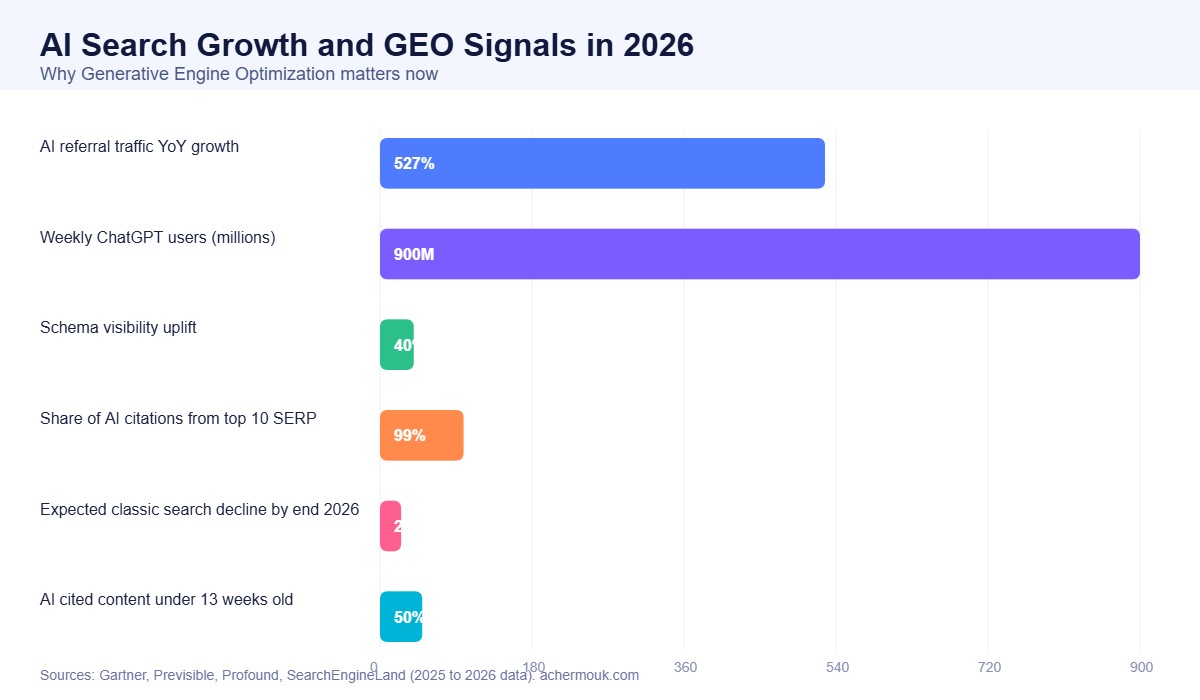
Search behavior has shifted faster in the last 18 months than in the previous 18 years. Users now ask long, conversational questions to AI assistants and expect a direct answer with sources. Search volume on traditional engines is projected to fall by around 25% by the end of 2026 according to Gartner, and the gap is being filled by AI chat experiences. Here is what the numbers look like today.
| Metric (2026) | Value | What It Means for You |
|---|---|---|
| Weekly ChatGPT users | 900M+ | A massive answer engine audience you cannot ignore |
| Year over year growth in AI referral traffic | +527% | Getting cited now compounds into real sessions |
| Expected decline of classic search by end of 2026 | -25% | Zero click searches are the new normal |
| Share of AI Overview citations from organic top 10 | 99% | You still need classic SEO to be eligible |
| Average age of content cited in AI answers | Under 13 weeks | Freshness and updates matter more than ever |
| Visibility uplift with proper schema | +30 to 40% | Structured data is now a GEO ranking lever |
GEO vs SEO vs AEO: Clear Differences
The acronym soup of SEO, AEO, and GEO confuses many teams. They are related but not the same. SEO ranks pages, AEO (Answer Engine Optimization) wins featured snippets and voice answers, and GEO earns citations inside generative AI responses. The table below shows the key differences at a glance.
| Dimension | SEO | AEO | GEO |
|---|---|---|---|
| Primary goal | Rank in blue links | Win featured snippets and voice answers | Get cited inside AI generated answers |
| Main surface | Google, Bing SERPs | Position zero, Google Assistant, Alexa | ChatGPT, Perplexity, Google AI Overviews, Claude, Gemini |
| Unit of success | Click from a ranked list | Direct answer read aloud or boxed | Brand mention, quoted sentence, linked citation |
| Content style | Comprehensive articles | Short, direct answers to specific questions | Structured, evidence backed, quotable passages |
| Key signals | Backlinks, relevance, CTR | Clear Q and A format, schema | Authority, citations, structured data, freshness |
| Measurement | Rankings, organic traffic | Snippet ownership | Share of AI citations, AI referral traffic |
How AI Search Engines Actually Choose Sources
To win at GEO, you need a simple mental model of how a generative engine builds an answer. Most modern AI search systems, including Google AI Overviews and Perplexity, use a pattern called retrieval augmented generation (RAG). The flow looks like this.
- Query understanding: the model rewrites the user question into one or several sub-questions.
- Retrieval: it searches a live index (Google, Bing, its own crawler) for the best matching pages.
- Chunking: it splits top pages into passages of 200 to 500 tokens each.
- Re-ranking: it scores each passage by relevance, clarity, freshness, and authority.
- Synthesis: it merges the best passages into a single answer and attaches citations.
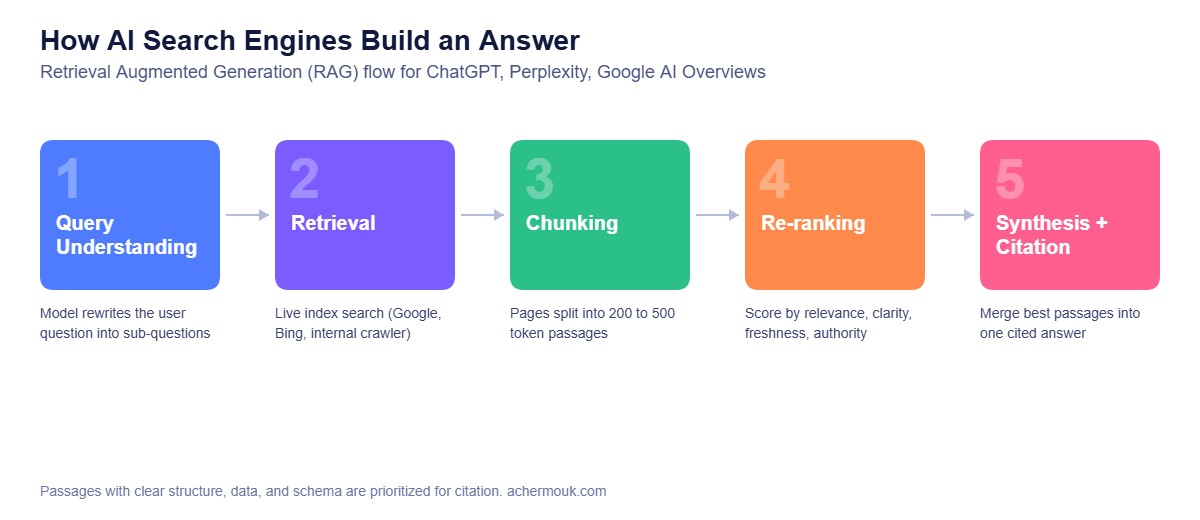
This changes what good content looks like. The model is not reading your page top to bottom. It is picking passages. If your page is a wall of text, passages are hard to extract. If your page has clear headings, short paragraphs, data tables, and direct answers, the model grabs those and quotes them. Think of every H2 section as a mini landing page for a sub-question.
10 Core GEO Strategies That Actually Work in 2026
These ten tactics come from analyzing thousands of AI citations across ChatGPT, Perplexity, and Google AI Overviews. They are ordered by impact.
- Answer the primary query in the first 200 words. Retrieval systems heavily weight the opening of the page. Lead with a direct, quotable definition or answer before any storytelling.
- Structure for passage retrieval. Use short paragraphs of 2 to 4 sentences, descriptive H2 and H3 headings phrased as questions or clear topics, and one idea per block.
- Add original data, numbers, and examples. AI engines prefer sources that add unique value. A single proprietary statistic can earn dozens of citations.
- Use comparison content. Analysis of AI citations shows comparison articles lead with about 32.5% of all citations, followed by opinion and best of lists.
- Publish deep, topical clusters. Cover a topic end to end across multiple linked pages so the model treats your site as the authority on that entity.
- Implement rich schema. Article, FAQPage, HowTo, Product, and Organization schema raise AI visibility by 30 to 40%.
- Strengthen E-E-A-T signals. Show real authors, credentials, citations to primary sources, and dates for both publication and last update.
- Keep content fresh. Half of AI cited content is under 13 weeks old. Build an update calendar, not just a publishing calendar.
- Earn brand mentions, not just backlinks. LLMs learn entities from co-occurrence. Unlinked mentions of your brand next to key topics help you get associated with that topic.
- Make your content machine readable. Clean HTML, no JavaScript only content, fast loading, accessible alt text, and semantic tags all help crawlers and AI agents parse the page.
The Ideal Content Blueprint for AI Citation
If you want a repeatable template your writers can follow, use the structure below. Every long form piece on your site should roughly match this anatomy.
| Section | Purpose | Target Length | GEO Notes |
|---|---|---|---|
| Title (H1) | Match the intent of the target query exactly | 55 to 65 characters | Include the primary keyword and the current year if evergreen |
| Opening answer | Directly answer the main question | 150 to 250 words | Quotable, self-contained, no fluff |
| Definition block | Define the main entity or concept | 50 to 100 words | One sentence definition, bolded term |
| Stats and context | Back the topic with numbers | 1 to 2 tables | Cite sources, use recent data |
| Comparisons | Show differences between options | 1 comparison table | Highly cited by AI engines |
| Step by step | Explain the how | 5 to 10 steps | Numbered list, imperative verbs |
| Examples and case studies | Prove it works | 2 to 3 mini cases | Include names, numbers, outcomes |
| FAQ | Cover long tail queries | 5 to 8 questions | Use FAQPage schema |
| Author box and sources | Signal E-E-A-T | Short | Link to credentials and references |
Technical GEO Checklist
Great content still loses if the technical layer blocks crawlers or confuses LLM agents. Walk through this checklist for every site you optimize.
- Server side render the main content. Do not rely on client side JavaScript to inject the article body.
- Keep Largest Contentful Paint under 2.5 seconds and Interaction to Next Paint under 200 ms.
- Submit an XML sitemap and make sure canonical URLs are correct.
- Allow reputable AI crawlers like GPTBot, PerplexityBot, Google-Extended, and ClaudeBot in robots.txt if you want citations.
- Use clean, hierarchical HTML: one H1, ordered H2 and H3, semantic tags like article, section, and nav.
- Add alt text that describes the image in context, not just the file name.
- Expose publication date, last updated date, and author in the HTML, not only in JavaScript.
- Implement HTTPS site wide with a valid certificate.
- Fix broken internal links and 404 errors. Dead ends reduce trust signals.
- Provide a llms.txt file for AI friendly discovery where supported.
Structured Data and Schema for GEO
Schema is the bridge between human readable content and machine understanding. AI engines actively use JSON-LD to understand what your page is, who wrote it, and how it relates to other entities. At a minimum, pair each content type with its matching schema.
| Content Type | Recommended Schema | Key Fields to Fill |
|---|---|---|
| Blog post or guide | Article, BlogPosting | headline, author, datePublished, dateModified, image |
| Tutorial | HowTo | step, totalTime, tool, supply |
| FAQ section | FAQPage | mainEntity with Question and Answer pairs |
| Product page | Product | name, brand, offers, aggregateRating, review |
| Service page | Service | serviceType, provider, areaServed |
| Business home page | Organization or LocalBusiness | name, logo, sameAs, contactPoint, address |
| Author bio | Person | name, jobTitle, sameAs, knowsAbout, alumniOf |
Here is a minimal Article schema example you can adapt for any WordPress post. Drop it inside a JSON-LD script tag in the head of the page.
{
  "@context": "https://schema.org",
  "@type": "Article",
  "headline": "Generative Engine Optimization in 2026",
  "author": {
    "@type": "Person",
    "name": "Mohamed Achermouk",
    "url": "https://achermouk.com"
  },
  "datePublished": "2026-04-16",
  "dateModified": "2026-04-16",
  "publisher": {
    "@type": "Organization",
    "name": "Achermouk",
    "logo": {
      "@type": "ImageObject",
      "url": "https://achermouk.com/logo.png"
    }
  },
  "mainEntityOfPage": "https://achermouk.com/geo-guide-2026/"
}
E-E-A-T in the AI Era
Google’s E-E-A-T framework (Experience, Expertise, Authoritativeness, Trustworthiness) is one of the strongest indirect signals used by AI systems that rely on Google or Bing for retrieval. The more your site demonstrates these four qualities, the more likely your content gets surfaced as a citation.
- Experience: show proof you have actually done the thing. Screenshots, before and after data, case studies, and client quotes work well.
- Expertise: attach real authors with credentials, bios, and links to their professional profiles.
- Authoritativeness: earn contextual mentions and backlinks from trusted industry sites.
- Trustworthiness: use HTTPS, show a physical address or business registration, list clear contact details, and keep privacy and terms pages up to date.
Best GEO Tools to Use in 2026
The GEO tool space has exploded. These are the categories and tools worth knowing, most of them with generous free tiers.
| Need | Recommended Tools | Why It Helps |
|---|---|---|
| Track AI citations | Profound, Peec AI, Otterly, HubSpot AI Search Grader | See when and how LLMs mention your brand |
| Classic SEO foundation | Ahrefs, Semrush, Google Search Console | Keyword research, technical audits, rankings |
| Content optimization | Frase, Surfer, Clearscope | Topical depth and entity coverage |
| Schema generation | Rank Math, Yoast, Merkle Schema Markup Generator | Ship JSON-LD fast without code |
| LLM prompt testing | ChatGPT, Perplexity, Gemini, Claude | Manually test your brand queries |
| WordPress performance | WP Rocket, LiteSpeed Cache, Perfmatters | Meet Core Web Vitals for AI crawlers |
Step by Step GEO Audit You Can Run Today
Use this 8 step audit on any page or site. It typically takes 60 to 90 minutes and gives you a clear action list.
- List your top 20 target queries. Pull them from Search Console, your sales calls, and competitor keyword gaps.
- Run each query in ChatGPT, Perplexity, and Google AI Overviews. Record who gets cited.
- Identify pages where you are missing. These are your priority targets.
- Audit the current top citations. Note their structure, length, headings, and data points.
- Rewrite your opening 200 words. Deliver a direct, quotable answer.
- Add comparison tables, data tables, and FAQ schema. Match or beat the cited source.
- Refresh the update date. Add a visible last updated stamp and new information.
- Re-test the same queries after 2 to 4 weeks. Track citation lift and adjust.
Common GEO Mistakes to Avoid
- Publishing thin, repetitive posts. AI engines ruthlessly filter these out.
- Relying only on keyword density. Entity coverage and clarity matter more.
- Blocking AI crawlers by accident in robots.txt or via WAF rules.
- Hiding publication and update dates.
- Using JavaScript only content that crawlers and LLM agents cannot see.
- Neglecting author bios and credentials.
- Ignoring brand monitoring. You cannot improve what you do not measure.
- Treating GEO as a one time project instead of a monthly refresh process.
Key Takeaway: SEO and GEO Are Better Together
In 2026 the winners of organic growth are the sites that treat SEO and GEO as one unified discipline. Strong technical SEO earns you a place in the retrieval index. Strong GEO formatting, schema, and authority signals earn you a cited spot inside AI answers. If you invest in one without the other, you leave half of your organic upside on the table.
Frequently Asked Questions About GEO
Is GEO replacing SEO in 2026?
No. GEO extends SEO rather than replacing it. Almost all AI citations still come from pages that already rank in the organic top 10. You need classic SEO as the foundation, then add GEO tactics on top to win citations inside AI answers.
How long does GEO take to show results?
Because most AI engines use real time or near real time retrieval, structural changes such as a rewritten intro, a new comparison table, or added schema can influence citations within 2 to 6 weeks. Authority driven signals like brand mentions and backlinks compound over 3 to 6 months.
Do I need a special plugin to do GEO on WordPress?
Not strictly. A solid SEO plugin like Rank Math or Yoast, combined with a caching plugin and a schema generator, covers the technical basics. The bigger lift is on the content side: writing quotable passages, adding tables, and keeping pages updated.
Should I block AI crawlers from my site?
Only if you have a strong reason, such as paywalled content or strict licensing. For most businesses, being cited by ChatGPT, Perplexity, Google AI Overviews, and Claude is a marketing win. Allow GPTBot, PerplexityBot, Google-Extended, and ClaudeBot unless you actively want to opt out.
What is the single most important GEO change I can make today?
Rewrite the first 200 words of your most important pages to deliver a direct, self contained answer to the main query, with the target term clearly defined in the first sentence. This one change alone often lifts AI citations within weeks.
Final Word
Generative Engine Optimization is where classic SEO was in 2010: early, underpriced, and full of leverage for the teams that move first. Treat every cornerstone article like a mini report, structure it for passage retrieval, back it with data and schema, and refresh it often. Do that consistently and you will not just rank in Google. You will become one of the default sources that AI assistants trust to answer your audience’s questions. If you need help auditing and upgrading your site for GEO, as a WordPress developer and SEO specialist based in Casablanca, I can help you turn your existing content into AI citation magnets.